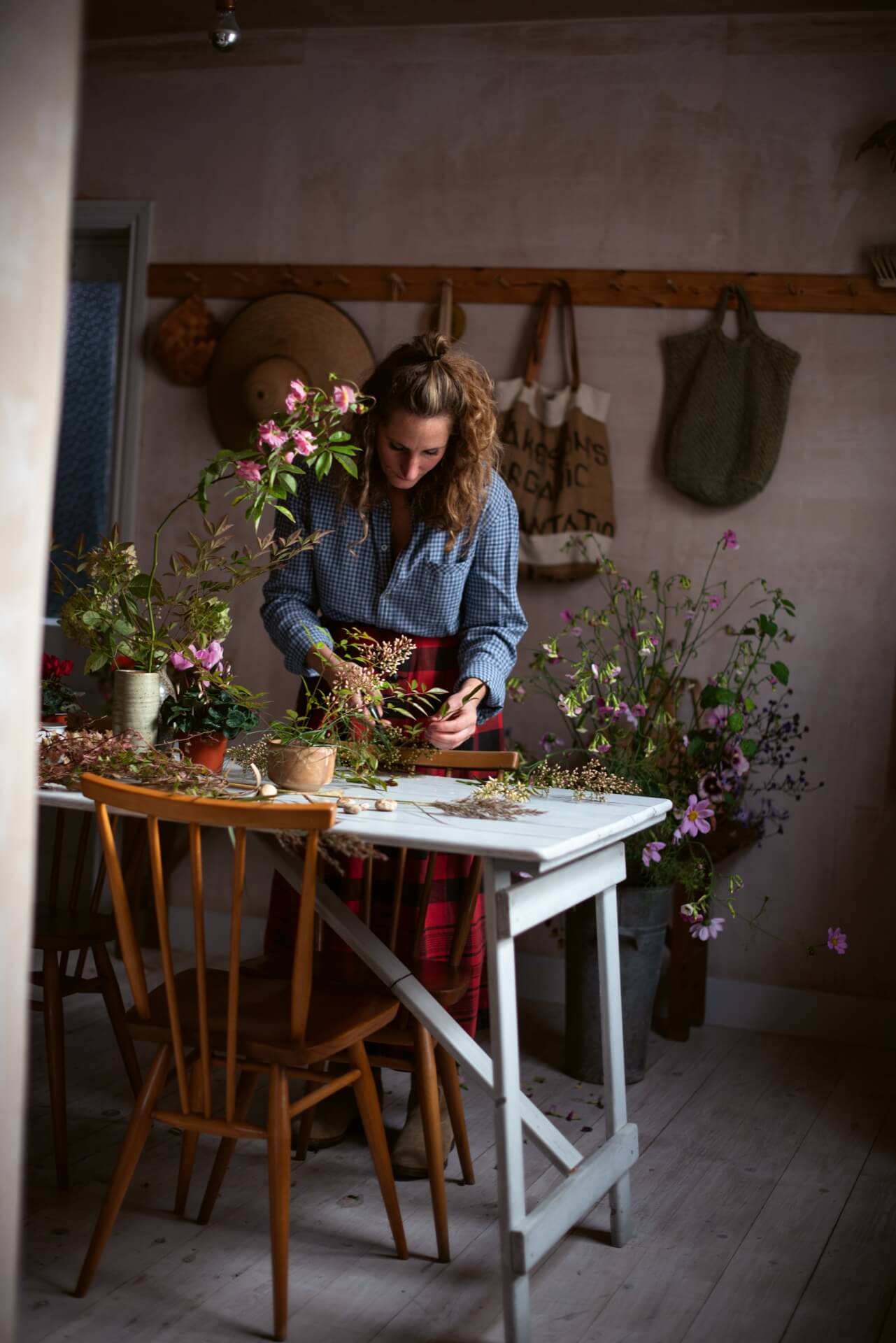

Hi Ally, can you tell us a little bit about what you do at AESME Studio?
AESME is a seasonal flower studio specialising in naturalistic floral arrangements using the finest seasonal materials organically grown at our Hampshire cutting garden. Over the past ten years we have provided floral design for hundreds of events in London, around the UK and abroad. We teach workshops at our London studio and have hosted retreats and workshops in France, Italy, Korea, Scotland and Kenya. During the pandemic we established a digital educational platform ‘Flowers on Film’, which is home to an extensive library of online courses and documentary-style films focused on garden-to-vase arrangements.This year we’re excited to be launching a new educational programme through the AESME SCHOOL OF FLOWERS and our first book Naturalistic Flowers will be published by Thames & Hudson.

 What inspired the idea behind the business? And how did you get it off the ground?
AESME began as a rather unlikely and tentative hobby that quickly became a full-blown passion and then a side hustle and then a business within a few years. I discovered the books of floral decorator and educator Constance Spry in a second-hand bookshop in my late twenties. Floral design had never been on my radar before this but I was fascinated by the artistic use of botanical materials other than commercially grown cut flowers – weeds, brambles, fruits, kale. That really ignited the initial spark. We began doing flowers for friends and family – small weddings and arrangements – and within a year or so began growing our own flowers because we couldn’t get the materials we wanted to use at the wholesale market. Very early on we moved from Oxford to London, found and renovated our studio which is in a Victorian railway arch in Shepherd’s Bush. It was such a great time – looking back we were incredibly naive but we learned by doing!
What is your professional background? What were you both doing before starting AESME?
In our twenties we had both moved around a lot, trying to find our way in various secretarial roles, marketing, events, fund-raising, retail… Nothing quite stuck. Jess wanted to be an illustrator and my dream was to be a writer. Both our parents were self employed and ran their own businesses and I think we absorbed a lot of their drive through osmosis. Then we fell into flowers and, as Jess likes to remind me, I was a thirty year old intern! But more than a decade later and we can’t imagine ever doing anything else.
How would you describe the AESME aesthetic?
Naturalistic. Our work is an attempt to evoke the way the plants look and behave in their setting whether in the wild or a cultivated space like a garden. So the aesthetic is very realistic, rather than abstract.

“We no longer adhere to the hierarchy of what is considered worthy in traditional floristry”

Are there themes or influences that run through your work?
We work strictly seasonally, using what is available week by week from the garden, or when we’re working further afield, using what is grown locally. Growing our own flowers has enabled us to discover how vastly varied our materials can be and we no longer adhere to the hierarchy of what is considered worthy in traditional floristry – we use weeds, branches, roots, moss, vegetables, seedheads and botanicals pre flower, peak flower and post flower!
Tell us a little about how you work and the creative process…
We feel that our designs should complement their setting and the season we’re in. Place is very important so when we’re working on an event we’ll look around at the surroundings to see what we can reference – what is growing outside the window, in the garden, in the immediate environment. We also take this one step further in creating garden-inspired designs that use materials that naturally grow together because of their location and position – shade-loving plants, drought-tolerant perennials. As Beth Chatto once said ‘right plant, right place’ and aesthetically this works for the vase too. So we always start with the plants, the materials, and go from there.
What does a typical working day look like at the studio?
Every day is so different and since we work so seasonally our workload shifts with the weather. In the deepest winter we are mainly indoors writing and editing content for our digital educational platform ‘Flowers on Film’. In the spring we gradually gear up to our ‘peak season’ which runs late April/May to September/October. Some days we’re harvesting at the garden, in which case we’re up at dawn, others we’re in the studio teaching or making arrangements for whatever project we have on that week.
What is the ethos behind your business?
AESME stands for: artistry, ecology, seasonality, materials and expression. Our manifesto is too long to reproduce in full here but it can be found on our website if you’d like to read more!

How did your book Naturalistic Flowers come about?
Our lovely editor Fleur reached out to see whether we were interested in writing a book and our immediate response was yes! It’s something we’ve always wanted to do and was a complete joy from start to finish.
Who is the book for? And what can readers expect to find within the pages?
The book is for anyone who loves flowers and plants. Florists and home flower arrangers, of course, but also gardeners, designers, cooks, anyone who loves nature and living in tune with the seasons!
What are the benefits for you and your business in authoring a book?
I think the process of writing the book was a very special one for Jess and I as sisters because we got to take a little time to get back to our ‘roots’ which was just arranging flowers for the sheer joy of creating, without a set brief or event to deliver. For the business I hope that the book will be found by people discovering floral design for the first time and that it will provide a more plant-led or nature-led alternative to more traditional floristry books. This supports our work through the AESME School of Flowers and it’s also lovely to have something physical to offer our customers for thoughtful gifting.
Is the online community important to your work?
Yes, very. We are privileged to be a part of an incredible like-minded community of flower and plant lovers dedicated to learning, to working seasonally and sustainably and using botanical materials as a means of creative self expression and connection.
“We try to stay very true to ourselves in everything we do and not get swept up by the latest trends”

Are you finding offline means of communication and marketing are becoming more important?
I think as with all things it’s all about maintaining a healthy balance. When we started Facebook was a big thing and Instagram was just taking off and it was a very different online landscape. We try to stay very true to ourselves in everything we do and not get swept up by the latest trends – certain things feel right and we know our audience who tend to prefer longer form content and means of communication. I think the way the world is going people are going to crave in-person, hands-on experiences more and more.
What does the next year hold for you?
This year we’re focussing on building and broadening our Flower School programme with a range of beautiful classes and workshops at our studio in London. We’ll be celebrating the publication of Naturalistic Flowers with various events including a launch in New York in August, as well as creating a new online course and developing our cutting garden in Hampshire. As always, plenty to be getting on with!
QUICKFIRE QUESTIONS
Books we love…
How to Do the Flowers by Constance Spry, The Well-Gardened Mind by Sue Stuart-Smith, Colour for Adventurous Gardeners by Christopher Lloyd, The Collector’s Garden by Ken Druse, Midweek Recipes by Jess Elliott Dennison and Hortus magazine.
Creative Heroes:
Alice Waters, Karen Blixen, Tom Stuart-Smith, Darina Allen, Isabella Tree, Dan Barber, Barbara Hepworth
Shops we love:
Choosing Keeping (for stationery), Couverture & the Garbstore, Margaret Howell, Studio Nicholson, Old Stone Trade (for clothes) The Japan House, Made in Cley (for vases), Postcard Teas (for tea!), Toppings and Daunt (for books).
Inspirational places:
We regularly visit Great Dixter in Sussex and Sissinghurst Castle in Kent; for garden inspiration there’s nowhere better!
————
Discover Ally and Jess’s work on their website: aesme.co.uk
Their first book Naturalistic Flowers – A Year of Plants, Places and People has just published with Thames and Hudson. The book takes the reader on a journey through the season, with the sisters visiting twelve unique locations throughout the UK, Europe and beyond. They explore each location through its regional flowers and scenery, gathering flowers and creating seasonal floral arrangements with a sense of place. Get your copy here
All images: © 2026 AESME STUDIO


Leave a Reply