
Hi Wendy! When and why did you decide to open the store?
I opened Chintz & Wood on June 7th, 2024. I moved back to England in 2023 with my partner Jubal Prevatte (a carpenter and woodworker). We moved from Portland, Oregon in the US to be closer to my family. I’d been in the US for 26 years, but my mother and sister were in East Sussex, and some old friends from my time living in Brighton, and I really wanted to spend more time with my mum. Unfortunately she died while we were completing the move and when I arrived in Worthing, I was at a bit of a loss for what to do. Then I saw the shop for sale and really it was a random decision. I decided to use the money my mum had left me to buy a shop and start a new venture. I wanted to take the opportunity to do something completely new and different.
Jubal had been making turned wood objects for some time and selling at markets in the US. I’d begun natural dyeing and really loved it. Having a shop seemed like a great way to find a market for our products and make new friends in Worthing, and to connect with the creative community in Sussex.

“Having a shop seemed like a great way to find a market for our products and make new friends in Worthing, and to connect with the creative community in Sussex.”

What had you done before? Did any of these skills help?
I’d spent 30 years researching and designing the future of technology – which is a long way from lampshades! Most of that time was spent at Intel in Portland and Seattle, most recently leading a user experience research and design team in Intel’s Client Computing Group. My team was exploring new uses of AI for creators and small businesses. My focus has always been on designing for people, understanding their daily lives and how they were using technology – or working out ways that technology could be useful or make their lives more enjoyable. I did ethnographic research that took me inside people’s homes all over the world. I also created designs and prototypes for new technologies.
All those years of doing in-home interviews means I’m very happy chatting to people – but of course now they are coming into my space! The shop obviously isn’t a private space, but it is an extension of my home in a strange way. Literally at times because the paintings do come from our home, which is why some of them aren’t for sale! I have some surprisingly intimate and profound conversations with people in the shop.
The other major skills I use are planning multiple projects, and managing budgets, both of which turn out to be very useful for running a small business. And spreadsheets, always spreadsheets!
Part of my non-working life was renovating the houses that we lived in, so the many hours spent poring through interiors magazines, or scrolling on Instagram and Pinterest, researching home decor and searching for the perfect cupboard handle or light fixture is definitely proving to be invaluable. One of my favourite activities is going to estate sales – definitely one of things I miss most about the US.
How did you decide on the name?
I had a list of different ideas. I really wanted a name that captured the content of the shop, which was memorable and unique and not too esoteric. Chintz & Wood brought together my work and Jubal’s, and it was available as a website and an Instagram handle which is a pretty important thing.
It felt very obvious to me but when we opened I was surprised how many people didn’t know what Chintz is. Chintz cotton fabric originated in 16th-century India, and was highly prized for its bright colours and hand-printed floral motifs which were produced using resist-dyeing and mordant techniques. The fabric was dyed using indigo and madder which I’m still using now. Chintz became so popular in Europe, first as luxury furnishing fabric and then used for clothes, that it was banned in the 18th century to protect local industries. Chintz had a big resurgence in the twentieth century but I think the IKEA “chuck out your chintz” advertising campaign was the death of it for many people. I’m delighted to see the floral fabrics coming back and Chintz regaining its rightful place.
“I really love taking unloved textiles and making them into something new and beautiful. I get very excited when I find vintage floral curtains in unfashionable colours in a charity shop.”


How would you describe the interior style of the store?
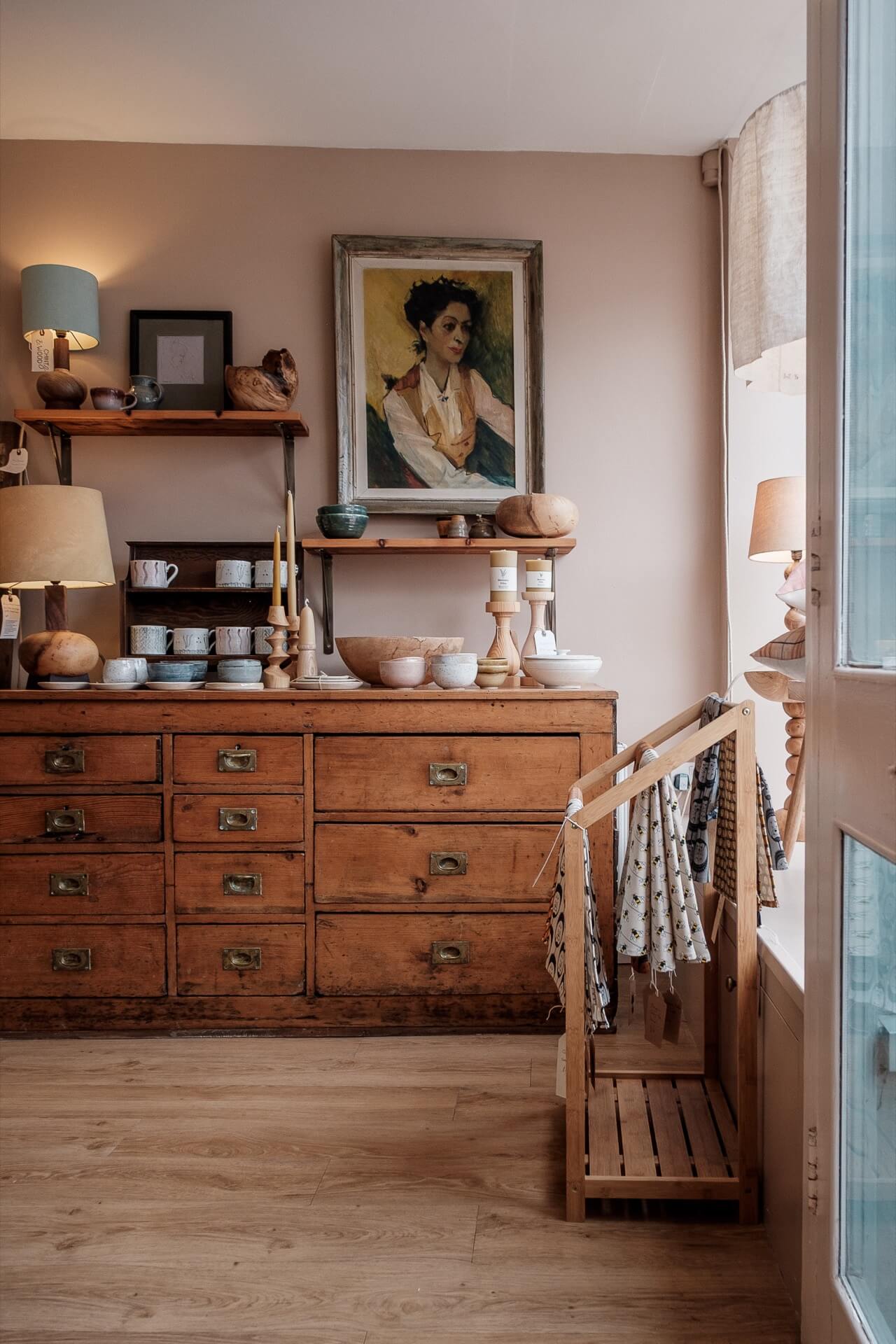
I like the shop to feel warm and comfortable. I painted the interior in Farrow and Ball’s Templeton Pink which is a warm plaster colour and looks fantastic with everything, especially the wooden objects and the soft pinks and yellows of natural dyes. Despite the chintz name it’s not ‘cottagey’, maybe more farmhouse. The store is also furnished with secondhand wooden furniture and vintage paintings, many of which have come from our home. It’s quite a small shop, so I don’t like it to seem too overpowering. It also smells very nice according to everyone who comes in – thanks to our gorgeous ranges of candles and soaps, made by fellow makers.
Tell us about the range of products you stock…
My hand-dyed and handmade cushions and lampshades (created using natural dyeing techniques on vintage and deadstock linens), and Jubal’s hand-turned lamp bases, candlesticks, stools and benches make up a large amount of the stock in the shop. We also stock ceramics from a number of Sussex potters, beeswax candles, hand-blocked and vintage textiles, locally made soaps, paper goods, and pure wool blankets. Nearly everything comes from fellow independent makers and businesses. I’ve loved getting to know all the artists and crafts people over the months the shop has been open.
A main focus of the store is making, especially with a sustainable theme. Can you tell us more about why this is important to you?
When I first went to a workshop on natural dyes I was really enchanted by the way I could make colour from unprepossessing things like onion skins or flowers. It was like being a child making potions in the garden. I loved the way it was such a natural process, that I could grow my own colour. Once I started looking for fabric to dye there seemed a perfect fit between the plant based dyes and reusing fabrics. At first I just used plain fabrics, but then an experiment with dyeing pattern fabric opened up a whole new set of options, and a whole world of reuse for unwanted fabrics.
People have become very aware of fast fashion and the enormous amount of clothing that is bought and thrown away. But about 42% of textile waste actually comes from home/interiors textiles. A recent study estimated that there are around 330 million unused home textile items in people’s homes. Unused sheets and curtains and towels most of which will eventually end up in the bin. It’s really hard to find a new use for home textiles, so I really love taking unloved textiles and making them into something new and beautiful. I get very excited when I find vintage floral curtains in unfashionable colours in a charity shop. I use plant based dyes to overdye the fabric, shifting the palette to pinks and oranges. It’s really an experimental process because the colours are always different, depending on the plant and the fabric.
Jubal makes all his wooden pieces from British wood, most of which is local. It comes from trees that have been felled for other reasons, and he often uses the parts like huge burr areas or the point where the branches split because that gives a more interesting material to work with, but those are not the parts that can be milled.

What does a ‘normal’ day look like?
My days always start with walking our dog along the beach. She is absolutely a Worthing dog (even though she moved from Portland with us) and loves the beach and we are there whatever the weather meeting all her dog friends. Then if it’s a shop day I walk down to the shop and open at 11am.
Shop days are a mixture of social and quiet. The social parts are chatting to friends and customers, and helping a customer decide on a purchase, or talking with a supplier dropping in a delivery. The quieter parts are ordering products and rearranging items, unpacking orders and pricing and labelling and updating the website and creating social media content, or doing accounts or redoing the windows, and lots of dusting!
I’ve recently moved my studio space upstairs in the shop, and that makes it easier to split my time between selling and making. I can make lampshades or do hand sewing while I’m downstairs in the shop, but other projects and machine sewing require a different sort of space.. Sometimes when it’s quiet I just put up a sign saying that I’m working upstairs and to ring the doorbell. It literally says “don’t worry you aren’t being a nuisance!”. It’s also the reason that the shop is open four days a week, so that I can have a day to dye fabrics or make cushions.
Home days are also shop days because I’m growing and picking dye flowers, sourcing fabrics, washing and preparing and dyeing fabrics, which all happens out in our garage.
As Jubal and I both make and make things together there are times when the shop completely takes over our home. Jubal and I both have studio spaces, but our dining table is still a focal point for discussion and staging products. We ate dinner in a forest of wooden christmas trees through December last year, and our conservatory is always full of work in progress items.
How do you choose and design your wares?
When I’m designing lampshade and cushions I’m working with the fabric that I have and how I think it will work with the dye, and then how the pattern will sit on a cushion form or on the curve of a lampshade. Then there is a lot of focus on the details that make an object feel special. For plain wools and linens, after dyeing I’ll add rows of sashiko stitching to give a subtle pattern. The cushions all have envelope backs with covered metal buttons to avoid using nylon zips. One of the choices for the lamp bases is using cotton or jute covered flex, which adds a textural feel.
I collect vintage and deadstock/surplus fabrics and then use natural dyes from different plants to shift the colours which gives them a unique look. Madder is a favourite dye, which comes from the roots of the madder plant. It gives a huge range of different colours from light pinks to deep reds and oranges. Madder has been used for centuries to dye fabrics and carpets. Last year I grew Japanese Indigo in my back garden. I used it fresh to dye silk and wool fabrics shades of turquoise and light green which I made into lampshades and cushions. Growing my own colour feels very slow home.
For products that I stock from other suppliers, it’s usually meeting people or seeing their work in a craft fair or online. I like to get to know the people whose work I stock, and where possible I avoid just ordering online. I’m generally not interested in stocking mass produced items which can make the whole process really slow and I also enjoy offering customers handmade items that are unique and something that little bit different.
Which item is your bestseller? Why do you think that is?
Our bestseller has to be our wooden Christmas trees which Jubal makes each year. He is busily preparing for this Christmas at the moment, as last year we sold hundreds. They are all unique, made by hand, and come in different woods and sizes. We have tiny baby ones that are part of a village gift box along with little wooden houses, to large industrial looking ones made from beach groyne wood with rusty holes through them.
The trees look wonderful in a group. Last year, we displayed them in the shop and it looked like a mini forest. They work for more than just Christmas and many people have them on display all year.

“Our bestseller has to be our wooden Christmas trees. They are all unique, and made by hand and come in different woods and sizes.”
 What items are your personal can’t-live-without?
Jubal’s hand-turned wooden bowls are incredibly useful in the shop and at home. I sell them in the shop, but I also use them to display other items. And at home there are wooden bowls everywhere. They hold keys by the front door, and remote controls on the coffee table, as well as fruit and salads on the dining table. We have a lot of bowls!
And woollen blankets. At the moment we have fabulous wool blankets by Bronte by Moon, made in Yorkshire from British wool. They make beautiful sofa throws but we also swap out our down duvet for blankets in the summer. Once we reach three layers of blankets we bring the duvet back! Our cats are very keen on blankets too.
What do you enjoy most about running the store?
I love creating the shop windows, and making the shop look beautiful from the outside. I hang big linen lampshades that I make from antique sheets that are lit at night because they make the shop glow from the street. Originally I saw them as a shop fitting but people want to buy them so I have to make new ones. At the moment the windows are full of dried flowers, wood shavings and pumpkins to celebrate ceramics and lampshades in autumnal oranges and dark greens.
The other great pleasure is getting to know my customers, and neighbouring businesses. Many of my customers come in regularly to chat or buy a gift or a card, and I’m gradually getting to know the other independent businesses in Worthing and around, who are all really supportive.
What has been your career highlight (so far!)?
When someone comes in and tells me how much they love something they bought from the shop. I recently had a couple who bought a matching pair of lampbases and shades, and then came back to buy three more lampshades because they liked them so much. I can see one of those lampshades when I walk past their house on the way home. It makes me happy everyday.

 What is the neighbourhood like around the store? Do you have a community of independent stores around you?
East Worthing or #EaMo as I’ve christened it (East of Montague Street) is wonderful. It is like a little village with an increasing number of independent shops and cafes, and we’re 3 minutes from the beach. I can see the sea from my upstairs workshop, which provides plenty of inspiration.
What do you wish you’d known before opening the store? Any advice for those thinking about opening their own shop?
I really didn’t realize how much time I would spend sourcing and ordering stock, especially at the beginning when everything feels like such a big decision. I had no idea how many I would sell of anything that I ordered and I still don’t to be honest. I have a bit more idea but retail is very unpredictable.
Coming from a corporate background one of the best things is having control, and being able to decide what I want to do. No one else can come and tell me that they are going to close down my project.
Being a very small business means I have to do everything myself, so I definitely miss having a team. It would be great to have access to some of my old team’s visual design skills, but the big thing I miss is having colleagues to brainstorm ideas with. Jubal and I work closely on some of the products, and will have lots of discussions about lamp bases and furniture, but the business part is my area, and that can feel quite lonely.
63 Brighton Rd, Worthing BN11 3EE



Leave a Reply